
Wednesday, November 25, 2026 | Today's Newsletter | Login
Asian Airlines Soar in World's Best Rankings
By Mata Press Service
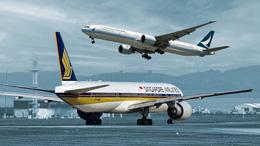
Asian and Middle Eastern airlines have emerged as the world's leading carriers in a new global ranking, with Singapore Airlines, Hong Kong's Cathay Pacific and several Chinese airlines outperforming many of their established American and European competitors.
The inaugural World's Best Airlines of 2027 ranking, released by TIME magazine and research firm Statista on November 18, places Dubai-based Emirates at number one, followed by Qatar Airways and Air New Zealand.
Singapore Airlines ranked fourth and Cathay Pacific fifth, while China's two aviation giants, China Southern Airlines and Air China, secured eighth and ninth places respectively.
Philippine Airlines also made the prestigious top 25, taking 23rd place, while Malaysia Airlines, AirAsia and several other prominent Asian carriers failed to make the published list.
The findings underline the growing strength of aviation in Asia and the Middle East, where airlines are competing aggressively for international travellers through better service, extensive flight networks and investments in passenger comfort.
No European airline made the world's top 10.
The TIME-Statista study combined passenger satisfaction surveys with an analysis of more than 30 million flights, measuring both customer experience and operational performance.
The results suggest that travellers increasingly value a combination of comfort, reliability and value for money as airlines contend with higher operating costs and growing competition for international passengers.
Singapore Airlines, which has long enjoyed a reputation for premium service and cabin comfort, finished fourth overall with 93.32 points, narrowly behind third-placed Air New Zealand's 93.47.
Hong Kong-based Cathay Pacific followed in fifth place with 92.63 points.
The strong showing puts both carriers among the world's aviation leaders as Singapore and Hong Kong compete to attract international passengers travelling between Asia, Europe, North America and Australia.
Singapore Airlines had already been named the world's best airline in the 2026 Skytrax World Airline Awards, demonstrating how different ranking systems can produce different winners.
Cathay Pacific's fifth-place finish also reinforces Hong Kong's importance as an international aviation hub.
China's airlines were another major feature of the TIME rankings.
China Southern Airlines placed eighth with 92.03 points, while Air China finished ninth with 91.99.
Three other mainland Chinese carriers made the top 25. Shandong Airlines ranked 18th, China Eastern Airlines 21st and Shenzhen Airlines 25th.
The five Chinese carriers in the top 25 reflect the scale and competitiveness of the country's aviation industry, particularly as domestic and international travel continues to recover and expand.
Their strong performance also shows that passenger satisfaction and operational reliability are no longer areas dominated by traditional Western airlines.
For Southeast Asia, Philippine Airlines' 23rd-place finish was another significant result.
The country's flag carrier scored 91.05 points, placing it among the world's 25 leading airlines.
Its inclusion is a positive development for an airline serving millions of Filipinos travelling internationally, including overseas workers and families maintaining close ties with relatives in North America, the Middle East and other parts of Asia.
The result is also significant for the Philippines as it seeks to strengthen international tourism and improve air connections with major overseas markets.
However, two of Southeast Asia's best-known aviation brands, Malaysia Airlines and budget carrier AirAsia, did not appear in the published top 25.
Their absence does not necessarily mean poor performance. The TIME rankings use a different methodology from other airline awards, with greater emphasis on combining passenger feedback with operational flight data.
For comparison, Malaysia Airlines ranked 21st in the 2026 Skytrax awards, while AirAsia was again named the world's best low-cost airline, winning that title for the 17th consecutive year.
The contrasting results highlight how airlines can perform differently depending on whether passengers are judging cabin service, ticket prices, punctuality or their overall travel experience.
Emirates topped the global ranking with 94.29 points, narrowly defeating Qatar Airways, which scored 94.16.
The Dubai-based airline also led the study's Best Value and Business Travel categories, reflecting its ability to attract both leisure and premium passengers.
Emirates president Sir Tim Clark attributed the recognition to continued investment in passenger services, aircraft interiors and the overall travel experience.
The airline has been expanding its premium economy offering and upgrading existing aircraft as it competes for passengers on routes connecting Asia with Europe, Africa and North America.
The dominance of Emirates and Qatar Airways illustrates the importance of Gulf aviation hubs for travellers heading to and from Asia, particularly those flying between South Asia, Southeast Asia and Western destinations.
For passengers in India, Pakistan, Bangladesh, Sri Lanka and the Philippines, Gulf carriers have become major options for long-distance international journeys.
Their extensive connecting networks have helped make Dubai and Doha important gateways for travellers moving between continents.
The TIME study surveyed international passengers between July 27 and September 4, 2026, asking them to evaluate airlines they had used during the previous three years.
The survey assessed factors including cabin comfort, service, entertainment, food and beverages, and value for money.
These responses were combined with flight performance information supplied by aviation data company OAG, covering more than 30 million flights operated between July 2025 and June 2026.
The study also published separate rankings covering reliability, business travel, long-haul flights, family friendliness and value.
Ryanair, the European budget carrier, topped the reliability category, showing that low-cost operators can compete strongly when operational efficiency is given greater weight.
The rankings come as airlines face pressure from rising fuel prices, aircraft delivery delays and higher operating expenses.
According to figures cited by TIME from the International Air Transport Association, the global airline industry was expected to generate US$1.17 trillion in revenue in 2026, but earn a net profit margin of just two per cent.
That leaves airlines with little room for error, despite strong travel demand.
For Asian travellers, the study offers another way to compare airlines when choosing flights, particularly on lengthy international journeys where comfort, connections and reliability can make a substantial difference.
For Asia's airlines, the rankings send a clear message. The region has established itself among the world's aviation leaders, and competition for passengers is becoming increasingly intense.
Leave a comment