
Wednesday, July 29, 2026 | Today's Newsletter | Login
The bizarre history of the 2400 Court Motel
By Maddi Dellplain,
Local Journalism Initiative Reporter
What do 19th-century colonial land grabs, al-Qaeda plots, modern horror movies and Syrian refugees all have in common? The 2400 Court Motel on Kingsway.
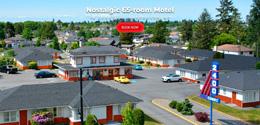
Driving through the Kingsway corridor, amid dense high-rises and ever-changing restaurants, retail and gas stations, one property looks frozen in time. The 2400 Court Motel at Kingsway and East 33rd Avenue typifies the blend of post-war austerity and optimism.
Built in 1946, the motel is, according to Heritage Vancouver, “one of the best remaining motor courts in the Lower Mainland,” in part because the site has been “scrupulously maintained” and “virtually unchanged” for decades.
That “of-another-time” feel has made the motel a versatile film and TV location. Most recently, it appeared as a nightmarish pastel-accented suburban backdrop in the horror film Backrooms. Before that, it showed up in projects from Bates Motel and The X-Files to Yellowjackets and The Exorcist.
“The amazing thing about the 2400 Court in particular is that it looks like this fantasy post-war utopia,” said James Burton, the now-retired lead consultant on the motel’s Statement of Significance. “It has bungalows that sit in the lawn with shrubbery underneath the windows and front porches. It looks like the typical post-war suburban development that was happening all over the country.”
But before it was a backdrop for horror shows and prestige TV, the 2400 Court captured the hearts of road trippers in the post-war prosperity boom.
“The 2400 Court [Motel] is an interesting remaining marker of that sudden change to automobile travel and tourism,” said Burton. “There were only a few hotels downtown at the time… then after the war, all these motel courts sprang up along Kingsway for visitors to Vancouver.”
To understand the motel’s significance, Burton said, you have to start with the history of the route it sits on. The road we know as Kingsway was once the main thoroughfare through what would later become Vancouver. Originally a well-trod First Nations trail, it was later widened and exploited by European colonizers.
The Royal Engineers, a contingent of the British Army, were sent from England during the 1858 gold rush to help secure British Columbia as a colony, amid fears of American expansion. As part of that effort, they built Westminster Road, a 13-mile route from New Westminster, the colonial capital, to Burrard Inlet.
Over time, the trail became a wagon road, then a streetcar line. With the advent of the automobile, Westminster Road was paved and widened, and in 1913 its name was officially changed to Kingsway.
Through the late 19th and early 20th centuries, middle-income families and waves of European migrants settled around Kingsway. The completion of the Pattullo Bridge in 1937 made Kingsway the northern section of a road system linking Vancouver to the U.S. West Coast and Mexico, cementing its role as the main approach into the city.
After the Pattullo Bridge opened, Kingsway’s dominance as a roadway was further underscored as it became the major artery for entering Vancouver from both the south and the east, said Burton.
With the post-war prosperity boom came a surge in car culture. “You were considered high on the hog if you went for a road trip… [Back then] you didn’t hop on a plane and go to Bosnia Herzegovina for a walk in the mountains,” Burton said. “You got in your car, you hoped it was as fancy and as big as possible, and you went for a drive in North America.”
Auto courts—the precursors to motels—and then motels themselves (a portmanteau of “motor” and “hotel”) were built with parking stalls directly in front of each room and often placed cars at the physical centre of the property.
Kingsway quickly filled with accommodations for road trippers, along with drive-ins and other car-centric amenities. Another symbol of car supremacy was the giant neon signage, like the towering sign in front of the 2400 Court.
“Vancouver was known as a city with streets that were fabulously lit up with neon,” Burton said, pointing to the Granville Strip and the Bowman sign on Broadway and Alder as relics of a neon-dominated era.
“It was the size of the signage that was big and new, in part to grab your attention as you were driving along,” he added. “You’re in an automobile on a modern road… [The signs] were meant to be apparent while you’re moving faster and can see them from further off.”
During the motel’s heyday in the 1960s and 1970s, Burton said, the grounds were meticulously maintained by the family who owned it.
But changes in regional transportation planning eventually set the stage for the motel’s decline. With the construction of the Massey Tunnel and the Oak Street Bridge in the late 1950s, Kingsway’s pre-eminence as the primary way into and out of Vancouver began to fade.
“[Things became] even more geared towards speed and volume of traffic, and introduced you into the city via Oak Street and Granville Street,” Burton said. “Ever since then, that has been the preferred route to the border.”
The opening of the Knight Street Bridge in 1974 diverted even more traffic away from Kingsway. As chain hotels proliferated and the main flows of traffic shifted, the charm and utility of auto-focused motels like the 2400 Court diminished. One by one, the other post-war motels along Kingsway closed, leaving the 2400 Court standing alone.
The City of Vancouver bought the property in 1989, marking the early stages of what would become the Norquay Village neighbourhood plan. Though the motel was no longer in its prime, the decades that followed were anything but quiet.
In November 1999, the 2400 Court became the focus of worldwide media when Algerian-born al-Qaeda member Ahmed Ressam, the so-called millennium bomber, used one of its rooms as a bomb-making factory. Ressam planned to attack Los Angeles International Airport on New Year’s Eve, but was arrested at the U.S.–Canada border with more than 100 pounds of explosives hidden in the wheel well of his rental car.
In 2006, the motel served as a sanctuary for Vancouver tenants forced out of their apartment building due to a leaking roof. In 2016, it temporarily housed about 27 Syrian refugee families fleeing that country’s civil war.
During the early COVID-19 pandemic, the site was again repurposed as temporary housing. Even today, as its future is being reshaped on paper, guests can still book a room at the iconic motor court.
The motel’s 3.2-acre property, encompassing 2396-2400 Kingsway and 2441-2493 East 33rd Avenue, is now set for a radical transformation. While redevelopment ideas have circulated since the late 1980s, council formally approved the Norquay Neighbourhood Centre plan in 2010.
A specific application to redevelop the site was submitted in October 2025, and council approved the rezoning this March, effectively sealing the 2400 Court Motel’s fate.
When complete, the project will replace the low-rise auto court with four large residential towers, the tallest rising 28 storeys. Plans call for a 20,000-square-foot public plaza with retail and restaurant space, plus more than an acre of publicly accessible outdoor areas including a playground, lawn and pavilion. All of the new homes will be market-rate rentals, with a mix of studios and one-, two- and three-bedroom units.
Leave a comment