
Thursday, October 22, 2026 | Today's Newsletter | Login
Asia Takes Climate Battle to Court
By Mata Press Service
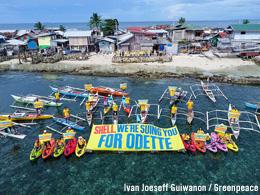
When Super Typhoon Rai tore across Batasan Island in the central Philippines in December 2021, Trixy Elle fled her home with her husband, two children and father as the storm closed in.
The family waded through rising water, holding tightly to one another as winds equivalent to a Category 5 hurricane battered the island.
By the next morning, their home was gone.
The disaster, known locally as Typhoon Odette, affected about 10.6 million people across the Philippines. More than 400 people were killed and 1.4 million were displaced.
For Elle, the destruction also raised a larger question.
Why, she wondered, were communities that contributed relatively little to global greenhouse gas emissions being forced to bear some of climate change’s heaviest costs?
That question would eventually take her thousands of kilometres from Bohol to a British courtroom.
In December 2025, Elle joined 66 other survivors in suing Shell at the Royal Courts of Justice in London. The plaintiffs allege the oil and gas giant’s historic emissions contributed to global warming and intensified disasters such as Typhoon Rai.
They are seeking compensation for deaths, injuries and property losses linked to the storm.
The case also alleges Shell understood the dangers posed by climate change decades ago, while continuing operations that contributed to rising global emissions.
Researchers have found that warming oceans and a changing climate are increasing the destructive potential of tropical cyclones.
The Philippine lawsuit is being closely watched because it is believed to be the first civil action seeking to directly connect the emissions of a major fossil fuel company with deaths and injuries caused by climate impacts in the Global South.
It is also part of a wider shift taking place across Asia.
Climate lawsuits have expanded rapidly worldwide during the past decade, although the overwhelming majority have been filed outside the developing countries facing some of the greatest climate risks.
By mid-2025, 3,099 climate-related cases had been recorded globally, according to the Sabin Center for Climate Change Law.
Nearly two-thirds originated in the United States.
Outside the U.S., Europe accounted for about 32 per cent of cases, while Asia represented just 6 per cent and Africa 2 per cent.
Those numbers are beginning to move.
Jolene Lin, director of the Asia-Pacific Centre for Environmental Law, said climate litigation in Asia has long been dismissed as unlikely to gain traction.
“I remember years ago people would say climate litigation would never take off in Asia because it’s not part of the Asian culture to fight poverty and … to litigate,” she said.
Lin argues that culture is not the main obstacle.
In parts of Asia, courts struggle with political interference, corruption and limited judicial independence. Many judges have also had little exposure to climate science or the rapidly developing field of climate law.
Restrictions on freedom of speech and association can create another hurdle by making it harder for activists and affected communities to organize cases.
Despite those obstacles, several landmark decisions suggest the legal landscape is shifting.
Lin points to 2024 as an important turning point.
South Korea’s Constitutional Court ruled that parts of the country’s Carbon Neutrality Act were unconstitutional because they failed to adequately protect future generations.
The challenge was brought by Youth 4 Climate Action, a youth-led environmental movement that has organized climate strikes and campaigned for faster adoption of clean energy.
The ruling put constitutional rights at the centre of South Korea’s climate obligations and increased pressure on the government to adopt stronger long-term emissions policies.
India’s Supreme Court also broke new ground in 2024 by recognizing protection from the harmful effects of climate change as part of constitutionally protected fundamental rights.
That decision emerged from an unusual dispute involving efforts to save the critically endangered Great Indian Bustard.
Conservationists had raised concerns about birds being killed after colliding with overhead electricity transmission lines associated with the expansion of renewable energy projects.
The court’s decision widened the legal debate well beyond the fate of a single species by connecting climate protection to constitutional rights.
Malaysia has now joined the region’s emerging climate litigation movement.
In January 2026, environmental watchdog RimbaWatch brought what it described as the country’s first greenwashing climate case against the federal government.
The complaint centres on allegations that a fossil fuel-derived product was misleadingly promoted as carbon neutral.
For climate campaigners, the significance of the case extends beyond whether the plaintiffs ultimately win.
Kuberan Hansrajh Kumaresan, RimbaWatch’s head of legal advocacy, said Malaysia’s first major climate lawsuit will help establish how courts interpret government and corporate climate responsibilities under laws already on the books.
Some Asian communities are also looking beyond their own legal systems and suing major corporations in the countries where those companies are headquartered.
That is the strategy behind the Philippine case against Shell in Britain.
Jefferson Chua, a campaigner with Greenpeace Philippines, said countries such as the United Kingdom have more developed climate case law and stronger mechanisms for testing corporate responsibility.
A similar approach is being used by residents of Pari Island in Indonesia.
Four islanders filed a case in Switzerland against cement giant Holcim in 2023, arguing that the company’s emissions contributed to the rising seas and repeated flooding threatening their homes.
The plaintiffs want Holcim to cut its emissions by 69 per cent from 2019 levels by 2040.
They are also seeking compensation for climate-related damage and financial support for flood protection measures on the island.
A Swiss court agreed in December 2025 to allow the case to proceed.
Leave a comment