
Thursday, October 22, 2026 | Today's Newsletter | Login
B.C.’s disastrous debt binge continues
Commentary
By Tegan Hill and Milagros Palacios
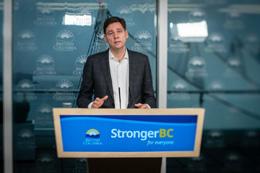
British Columbia’s recent year-end financial update provides further evidence of the province’s disastrous fiscal position, which should worry everyone in the province. For the last fiscal year (2024/25), the province recorded its largest deficit on record at $7.3 billion. Total provincial debt reached $133.9 billion, rising nearly 50 per cent during Premier David Eby’s first two years in office.
But Eby can’t blame COVID or President Trump’s tariffs for his record-high deficit or rapid debt accumulation. The worst of COVID was over when he took office in 2022, and the impact of Trump’s tariffs won’t show up until this year (2025/26). Instead, the province’s debt accumulation is the result of a serious ongoing spending problem.
In fact, Premier Eby recorded the second-highest year of per-person (inflation-adjusted) program spending ($15,012) on record in 2023 (the latest year of comparable data), surpassed only by Premier John Horgan ($15,090) in 2022. When COVID-related spending is removed, 2023 under Eby is the highest spending year recorded.
From 1969 to 2024, a period of 55 years for which there is comparable data, Premier Eby also holds the record for the largest average increase in debt of any B.C. premier during his government’s two years in office (on a per person inflation-adjusted basis)—even before this latest fiscal update. Correspondingly, British Columbia has quickly gone from being one of the most fiscally sound provinces to becoming one of the most indebted.
Let’s take a closer look at the numbers.
Premier Eby will record his second budget deficit in 2024/25, but that’s only one piece of the province’s debt accumulation. Once long-term spending on capital projects is factored in (e.g. spending on schools and highways) total provincial debt reached $133.9 billion, or $23,494 per British Columbian in 2024/25.
Of course, British Columbians must pay for government debt through interest payments and potentially higher taxes in the future. In 2024/25, debt interest payments were $745 per British Columbian, representing the portion of their tax dollars that is not used for services like healthcare or education, but rather to pay bondholders' interest on existing debt.
Unfortunately, the fiscal outlook is even bleaker. In Budget 2025, the province projected a record-high $10.9 billion budget deficit this year followed by deficits of around $10 billion in each of the next two years. Total provincial debt is projected to surpass $200 billion by 2027/28—more than doubling under Premier Eby’s short leadership.
Several economists have warned that the province’s fiscal position will likely be even worse than projected due to a loss of revenue (namely, from the consumer carbon tax, which was set to zero effective April 2025), recent credit downgrades (which can increase the cost of government borrowing), and weaker economic growth.
B.C. debt continues to skyrocket, fuelled by increased government spending. Without a course change, British Columbia’s disastrous fiscal position is projected to worsen in the years ahead.
Tegan Hill is Director, Alberta Policy at the Fraser Institute. Milagros Palacios is the Director for the Addington Centre for Measurement at the Fraser Institute.
Leave a comment